
Article Sidebar
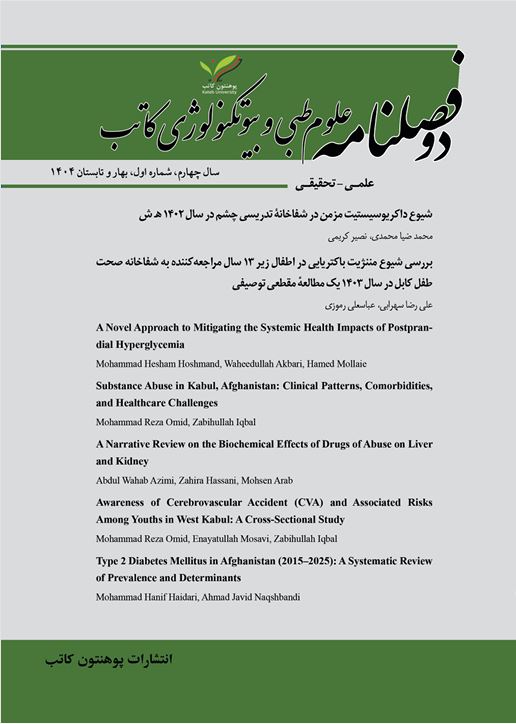
A Novel Approach to Mitigating the Systemic Health Impacts of Postprandial Hyperglycemia
Main Article Content
Abstract
Introduction: Postprandial hyperglycemia (PPHG) is a common metabolic disorder in both type 1 and type 2 diabetes and plays a significant role in the development of microvascular and macrovascular complications. Elevated blood glucose levels after meals, through mechanisms such as oxidative stress, inflammation, and pancreatic beta-cell dysfunction, can lead to vascular damage and progression of chronic diabetic complications.
Materials and Methods: This study was conducted as a narrative review. Scientific literature was searched in PubMed, Scopus, Web of Science, and Google Scholar databases. Studies related to non-pharmacological and pharmacological interventions effective in controlling postprandial hyperglycemia including post-meal physical activity, consumption of fiber or vegetables before meals, vinegar intake, low glycemic index diets, insulin therapy, and GLP-1 receptor agonists were reviewed and qualitatively analyzed.
Results: The reviewed studies indicated that inadequate control of PPHG is associated with an increased risk of microvascular complications such as retinopathy, nephropathy, and neuropathy, as well as macrovascular complications including cardiovascular diseases. Lifestyle interventions, particularly low–glycemic index diets and regular physical activity, play an effective role in reducing postprandial blood glucose levels. However, pharmacological treatments alone are not sufficient to achieve complete control of PPHG in all patients.
Conclusion: Effective control of postprandial hyperglycemia requires a multifaceted approach that includes dietary modification, increased physical activity, appropriate pharmacological therapy, and careful blood glucose monitoring. Given the limited long-term evidence, future studies are needed to evaluate the sustained effectiveness of these interventions and to explore the use of novel continuous glucose monitoring technologies.
Keywords
Article Details
How to Cite
Most read articles by the same author(s)
- Yasin Mohammadi, Hamed Mollaie, Waheedull Akbari, Yaser Hussainkhai, Jomagul Malilzada, Monkeypox Virus: Epidemiology, Transmission, and Clinical Management in the Contemporary Era , Kateb Journal of Medical Science & Biotechnology : Vol. 3 No. 1 (1403): Vol. 3, No. 1, Spring & Summer 2024
Similar Articles
- Mohammad Hanif Haidari, Ahmad Javid Naqshbandi, Type 2 Diabetes Mellitus in Afghanistan (2015–2025): A Systematic Review of Prevalence and Determinants , Kateb Journal of Medical Science & Biotechnology : Vol. 4 No. 1 (1404): Vol. 4, No 1, Spring & Summer 2025
- Hadi Sadiqi, Ghulam Mohammad Amiri, Qasem Rezaee, Mustafa Ahmadzada, Ghulam Haider Jamalzada, The Global Impact of Preeclampsia on Maternal Mortality: A Comparative Analysis of Healthcare Accessibility and Outcomes in Low and Middle-Income Countries Comparing High-Income Countries , Kateb Journal of Medical Science & Biotechnology : Vol. 2 No. 2 (1402): Vol. 2, No 2, Autumn & Winter 2023-2024
- Ahmadali Afzali, Wahidullah Naimi, First report of infants of diabetic mothers frequency in Afghanistan , Kateb Journal of Medical Science & Biotechnology : Vol. 1 No. 2 (1401): Vol. 1, No 2, Autumn & Winter 2022-2023
- Abdullah Rastin, Mirwais Ramozi, Abass Ali Ramozi, Jawed Jahid, Prevalence and Associated Factors of Chronic Kidney Disease Patients in Wazir Mohammad Akbar Khan Hospital in Kabul, Afghanistan , Kateb Journal of Medical Science & Biotechnology : Vol. 2 No. 1 (1402): Vol. 2, No. 1, Spring & Summer 2023
- Abbas Ali Ramozi, Ali Ahmad Yusefi, Ehsan Shayan, Yahya Samadi, Zakaria Rezai, Mirwais Ramozi, Demographic and Associated Factors Influencing Addiction Among Adults in Kabul, Afghanistan , Kateb Journal of Medical Science & Biotechnology : Vol. 3 No. 2 (1403): Vol. 3, No. 2, Autumn 2024 & Winter 2025
- Abdul Wahab Azimi, Zahira Hassani, Mohsen Arab, A Narrative Review on the Biochemical Effects of Drugs of Abuse on Liver and Kidney , Kateb Journal of Medical Science & Biotechnology : Vol. 4 No. 1 (1404): Vol. 4, No 1, Spring & Summer 2025
- Zabihullah Iqbal, Ali Ahmad Yousefi, Rahim Hassili, Abuzar Afzali, Investigation of Leishmaniasis Events in Afghanistan , Kateb Journal of Medical Science & Biotechnology : Vol. 2 No. 1 (1402): Vol. 2, No. 1, Spring & Summer 2023
- Muzhgan Afzali, Ahmad Faisal Afzali, Ahmad Komail Afzali, Risk Factors for the Incidence of Breast Cancer in Postmenopausal Women , Kateb Journal of Medical Science & Biotechnology : Vol. 3 No. 2 (1403): Vol. 3, No. 2, Autumn 2024 & Winter 2025
- Ali Reza Sohrabi, Hosain Barati, Hussain Ali Sultanfar, The prevalence of glaucoma cases at the Teaching Eye Hospital in the year 1401 AH , Kateb Journal of Medical Science & Biotechnology : Vol. 2 No. 1 (1402): Vol. 2, No. 1, Spring & Summer 2023
- Zabihullah Iqbal, Enayatullah Mosawi, Mohammad Reza Omid, Awareness of Hypertension and Its Risks Among Youths in West Kabul: A Cross-Sectional Study , Kateb Journal of Medical Science & Biotechnology : Vol. 3 No. 2 (1403): Vol. 3, No. 2, Autumn 2024 & Winter 2025
You may also start an advanced similarity search for this article.