
Article Sidebar
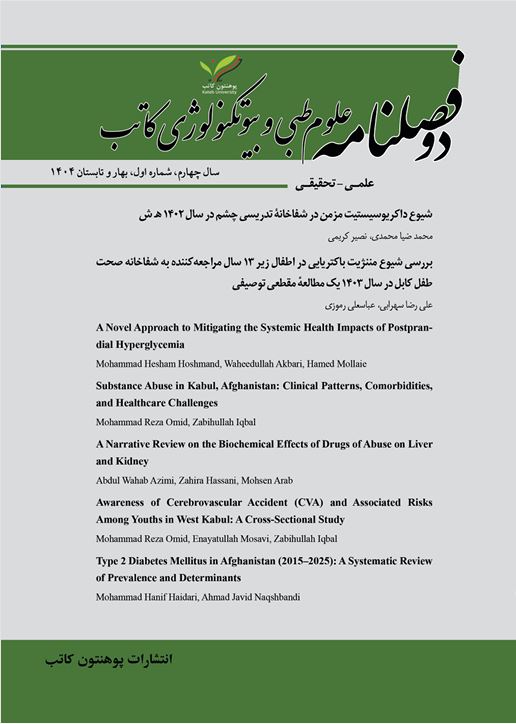
A Novel Approach to Mitigating the Systemic Health Impacts of Postprandial Hyperglycemia
Main Article Content
Abstract
Introduction: Postprandial hyperglycemia (PPHG) is a common metabolic disorder in both type 1 and type 2 diabetes and plays a significant role in the development of microvascular and macrovascular complications. Elevated blood glucose levels after meals, through mechanisms such as oxidative stress, inflammation, and pancreatic beta-cell dysfunction, can lead to vascular damage and progression of chronic diabetic complications.
Materials and Methods: This study was conducted as a narrative review. Scientific literature was searched in PubMed, Scopus, Web of Science, and Google Scholar databases. Studies related to non-pharmacological and pharmacological interventions effective in controlling postprandial hyperglycemia including post-meal physical activity, consumption of fiber or vegetables before meals, vinegar intake, low glycemic index diets, insulin therapy, and GLP-1 receptor agonists were reviewed and qualitatively analyzed.
Results: The reviewed studies indicated that inadequate control of PPHG is associated with an increased risk of microvascular complications such as retinopathy, nephropathy, and neuropathy, as well as macrovascular complications including cardiovascular diseases. Lifestyle interventions, particularly low–glycemic index diets and regular physical activity, play an effective role in reducing postprandial blood glucose levels. However, pharmacological treatments alone are not sufficient to achieve complete control of PPHG in all patients.
Conclusion: Effective control of postprandial hyperglycemia requires a multifaceted approach that includes dietary modification, increased physical activity, appropriate pharmacological therapy, and careful blood glucose monitoring. Given the limited long-term evidence, future studies are needed to evaluate the sustained effectiveness of these interventions and to explore the use of novel continuous glucose monitoring technologies.
Keywords
Article Details
How to Cite
Most read articles by the same author(s)
- Yasin Mohammadi, Hamed Mollaie, Waheedull Akbari, Yaser Hussainkhai, Jomagul Malilzada, Monkeypox Virus: Epidemiology, Transmission, and Clinical Management in the Contemporary Era , Kateb Journal of Medical Science & Biotechnology : Vol. 3 No. 1 (1403): Vol. 3, No. 1, Spring & Summer 2024
Similar Articles
- Bealddues Levy Perdon, Attaullah Ahmadi, Xu Lin, Ryan Rachmad Nugraha, Mashkur Abdulhamid Isa, Yllen Law Cablinda, Zerez Lei Mercado, Yakobus Lau De Yung Sinaga, Shingin Kovona Musa, Don Eliseo Lucero Prisno, The Low and Slow COVID-19 Pandemic of Timor-Leste , Kateb Journal of Medical Science & Biotechnology : Vol. 1 No. 1 (1401): Vol. 1, No 1, Spring & Summer 2021
- Zafer Cakir, Hasan Basri Savas, Abbas Ali Ramozi, Shafi Ullah Zahid, Kalimullah Wardak, Determination of the Course of COVID-19 Pandemic Using Modified Mathematical Modeling , Kateb Journal of Medical Science & Biotechnology : Vol. 1 No. 1 (1401): Vol. 1, No 1, Spring & Summer 2021
- Sayed Hamid Mosavi, Seyed Alireza Mesbah Namin, Real Time PCR; A new, fast and accurate technique in diagnosing the severe type of hemophilia A patients , Kateb Journal of Medical Science & Biotechnology : Vol. 1 No. 1 (1401): Vol. 1, No 1, Spring & Summer 2021
- Mohammad Reza Omid, Enayatullah Mosawi, Zabihullah Iqbal, Awareness of Cerebrovascular Accident (CVA) and Associated Risks Among Youths in West Kabul: A Cross-Sectional Study , Kateb Journal of Medical Science & Biotechnology : Vol. 4 No. 1 (1404): Vol. 4, No 1, Spring & Summer 2025
- Mohammad Reza Omid, Zabihullah Iqbal, Substance Abuse in Kabul, Afghanistan: Clinical Patterns, Comorbidities, and Healthcare Challenges , Kateb Journal of Medical Science & Biotechnology : Vol. 4 No. 1 (1404): Vol. 4, No 1, Spring & Summer 2025
- Abass Ali Ramozi, Ali Ahmad Yousefi, Mirwais Ramozi, Abdullah Rastin, Ehsan Shayan, Prevalence and Associated Factors of Genetic Disorders and Congenital Abnormalities in Consanguineous Marriages in Afghanistan , Kateb Journal of Medical Science & Biotechnology : Vol. 2 No. 1 (1402): Vol. 2, No. 1, Spring & Summer 2023
- Abass Ali Ramozi, Ali Ahmad Yousefi, Qasem Rezaee, Interconnected Impacts of COVID-19: A Meta-Analysis on Public Health and Economic Disparities , Kateb Journal of Medical Science & Biotechnology : Vol. 2 No. 2 (1402): Vol. 2, No 2, Autumn & Winter 2023-2024
- Shah Jahan Shayan, The Capacity of Health Research in Afghanistan: Bibliometric Analysis , Kateb Journal of Medical Science & Biotechnology : Vol. 1 No. 2 (1401): Vol. 1, No 2, Autumn & Winter 2022-2023
- Zahra Akhlaghi, Gholamreza Sharifzadeh, Mohammadreza Miri, Investigation on the age of menarche and its related factorsinsecondary school girl students in Birjand-Iran , Kateb Journal of Medical Science & Biotechnology : Vol. 1 No. 2 (1401): Vol. 1, No 2, Autumn & Winter 2022-2023
- Sima Alizada, The Impact of Childbirth Preparation Classes on Reducing Fear of Natural Childbirth , Kateb Journal of Medical Science & Biotechnology : Vol. 3 No. 1 (1403): Vol. 3, No. 1, Spring & Summer 2024
You may also start an advanced similarity search for this article.