
Article Sidebar
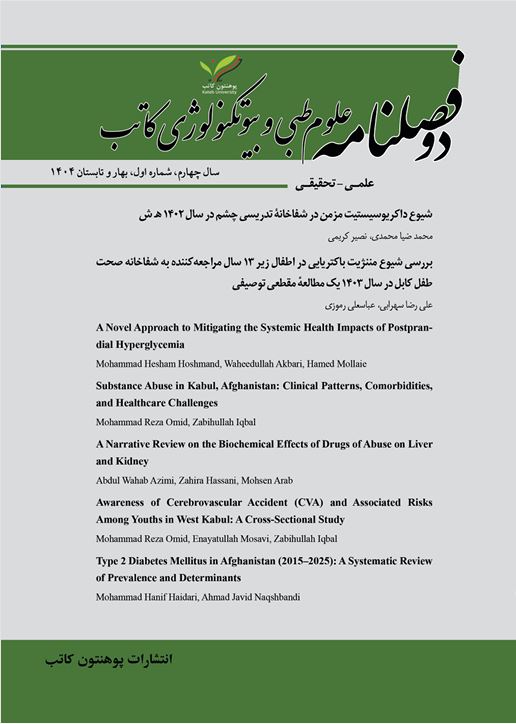
Substance Abuse in Kabul, Afghanistan: Clinical Patterns, Comorbidities, and Healthcare Challenges
Main Article Content
Abstract
Background: Substance abuse represents a major public health problem in Afghanistan, with its high prevalence among adults aged 18 to 40 years. Besides social complications, there are physical and psychological complications. Consequently, it places a high burden on the healthcare system. Patterns, comorbidities, and healthcare challenges posed by substance use must be understood in order to intervene effectively.
Methods: A cross-sectional survey was conducted among 1,500 adults (aged 18–40 years) using convenience and snowball sampling in community and public settings across Kabul. Data were collected using a structured questionnaire adapted from previously published instruments and administered in local languages (Dari and Pashto). The questionnaire captured demographic characteristics, substance use patterns, clinical symptoms, and healthcare access. Descriptive statistics and cross-tabulations were performed using SPSS.
Results: 68% of men reported substance use, primarily opioids (35%) and methamphetamines (25%). Malnutrition accounted for 45% of physical complications, infections for 12%, and anxiety for 25% and depression for 48% of mental health issues. 42% of women reported using cannabis and opioids, with fewer health issues. Misconceptions regarding the dangers of drugs were widespread, and only 30% had access to healthcare services.
Conclusion: Substance misuse among Afghan adults constitutes a serious health problem in the 18-40-year-old age group, for whom access to healthcare itself is very challenging. Urgent interventions through community-based programs, awareness programs, and policy initiatives are required to reduce harms and improve public health outcomes.
Keywords
Article Details
How to Cite
Most read articles by the same author(s)
- Zabihullah Iqbal, Enayatullah Mosawi, Mohammad Reza Omid, Awareness of Hypertension and Its Risks Among Youths in West Kabul: A Cross-Sectional Study , Kateb Journal of Medical Science & Biotechnology : Vol. 3 No. 2 (1403): Vol. 3, No. 2, Autumn 2024 & Winter 2025
- Mohammad Reza Omid, Enayatullah Mosawi, Zabihullah Iqbal, Awareness of Cerebrovascular Accident (CVA) and Associated Risks Among Youths in West Kabul: A Cross-Sectional Study , Kateb Journal of Medical Science & Biotechnology : Vol. 4 No. 1 (1404): Vol. 4, No 1, Spring & Summer 2025
- Zabihullah Iqbal, Ali Ahmad Yousefi, Rahim Hassili, Abuzar Afzali, Investigation of Leishmaniasis Events in Afghanistan , Kateb Journal of Medical Science & Biotechnology : Vol. 2 No. 1 (1402): Vol. 2, No. 1, Spring & Summer 2023
- Zabihullah Iqbal, Ali Ahmad Yousefi, Muhammad Asef, The Prevalence of toxoplasmosis in pregnant women of Ningarhar Province (2023) , Kateb Journal of Medical Science & Biotechnology : Vol. 2 No. 2 (1402): Vol. 2, No 2, Autumn & Winter 2023-2024
Similar Articles
- Zabihullah Iqbal, Ali Ahmad Yousefi, Rahim Hassili, Abuzar Afzali, Investigation of Leishmaniasis Events in Afghanistan , Kateb Journal of Medical Science & Biotechnology : Vol. 2 No. 1 (1402): Vol. 2, No. 1, Spring & Summer 2023
- Mohammad Reza Omid, Enayatullah Mosawi, Zabihullah Iqbal, Awareness of Cerebrovascular Accident (CVA) and Associated Risks Among Youths in West Kabul: A Cross-Sectional Study , Kateb Journal of Medical Science & Biotechnology : Vol. 4 No. 1 (1404): Vol. 4, No 1, Spring & Summer 2025
- Zabihullah Iqbal, Enayatullah Mosawi, Mohammad Reza Omid, Awareness of Hypertension and Its Risks Among Youths in West Kabul: A Cross-Sectional Study , Kateb Journal of Medical Science & Biotechnology : Vol. 3 No. 2 (1403): Vol. 3, No. 2, Autumn 2024 & Winter 2025
- Abass Ali Ramozi, Ali Ahmad Yousefi, Qasem Rezaee, Interconnected Impacts of COVID-19: A Meta-Analysis on Public Health and Economic Disparities , Kateb Journal of Medical Science & Biotechnology : Vol. 2 No. 2 (1402): Vol. 2, No 2, Autumn & Winter 2023-2024
- Mohammad Hesham Hoshmand, Waheedullah Akbari, Hamed Mollaie, A Novel Approach to Mitigating the Systemic Health Impacts of Postprandial Hyperglycemia , Kateb Journal of Medical Science & Biotechnology : Vol. 4 No. 1 (1404): Vol. 4, No 1, Spring & Summer 2025
- Ahmadali Afzali, Wahidullah Naimi, First report of infants of diabetic mothers frequency in Afghanistan , Kateb Journal of Medical Science & Biotechnology : Vol. 1 No. 2 (1401): Vol. 1, No 2, Autumn & Winter 2022-2023
- Muzhgan Afzali, Ahmad Faisal Afzali, Ahmad Komail Afzali, Risk Factors for the Incidence of Breast Cancer in Postmenopausal Women , Kateb Journal of Medical Science & Biotechnology : Vol. 3 No. 2 (1403): Vol. 3, No. 2, Autumn 2024 & Winter 2025
- Zabihullah Iqbal, Ali Ahmad Yousefi, Muhammad Asef, The Prevalence of toxoplasmosis in pregnant women of Ningarhar Province (2023) , Kateb Journal of Medical Science & Biotechnology : Vol. 2 No. 2 (1402): Vol. 2, No 2, Autumn & Winter 2023-2024
- Bealddues Levy Perdon, Attaullah Ahmadi, Xu Lin, Ryan Rachmad Nugraha, Mashkur Abdulhamid Isa, Yllen Law Cablinda, Zerez Lei Mercado, Yakobus Lau De Yung Sinaga, Shingin Kovona Musa, Don Eliseo Lucero Prisno, The Low and Slow COVID-19 Pandemic of Timor-Leste , Kateb Journal of Medical Science & Biotechnology : Vol. 1 No. 1 (1401): Vol. 1, No 1, Spring & Summer 2021
- Hassan Ali Daoud, Isaac Olushola Ogunkola, Attaullah Ahmadi, Yidnekachew Girma Mogessie, Yasir Ahmed Mohammed Elhadi, Yusuff Adebayo Adebisi, Don Eliseo Lucero Prisno, Somaliland: a self-declared country’s fight against COVID-19 , Kateb Journal of Medical Science & Biotechnology : Vol. 1 No. 1 (1401): Vol. 1, No 1, Spring & Summer 2021
You may also start an advanced similarity search for this article.