
Article Sidebar
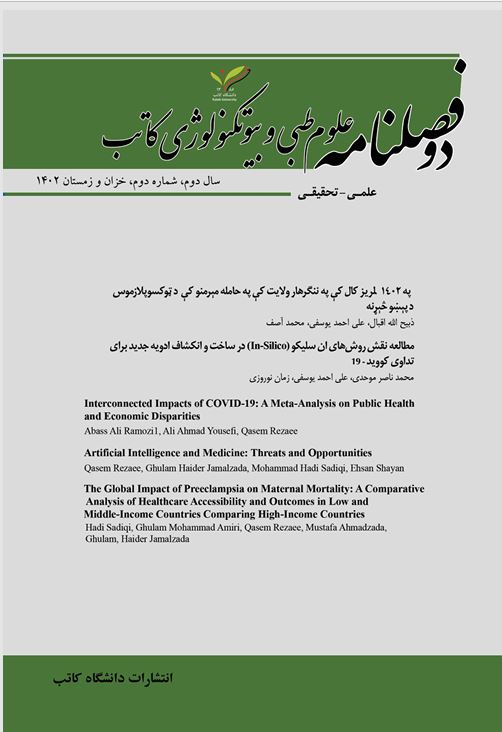
Artificial Intelligence and Medicine: Threats and Opportunities
Main Article Content
Abstract
Background: Artificial intelligence (AI) is transforming healthcare by advancing diagnostic accuracy, optimizing treatment pathways, and enabling personalized medicine and efficient administrative processes. Despite these advancements, its adoption raises ethical, legal, and operational challenges. This review critically examines AI’s dual impact on healthcare by assessing its applications in diagnostics, robotic-assisted surgery, predictive analytics, drug discovery, and telemedicine while addressing key concerns like data privacy, algorithmic bias, workforce implications, and technological dependency.
Methodology: A systematic review of peer-reviewed literature published between 2018 and 2024 was conducted using databases such as PubMed, Web of Science, and Google Scholar. Search terms included "artificial intelligence in clinical practice," "machine learning ethics in medicine," "AI-driven diagnostics," and "healthcare predictive analytics." Articles were selected based on their relevance to AI's clinical applications and ethical implications, emphasizing qualitative evaluations and real-world case studies in diagnostic imaging, minimally invasive surgery, pharmacological innovation, and virtual healthcare delivery.
Results: AI has shown significant promise in enhancing healthcare outcomes, particularly in achieving diagnostic accuracies on par with or exceeding human expertise in imaging and pathology. It has accelerated drug development pipelines, improved surgical precision, and streamlined clinical workflows. However, the review highlights persistent challenges, including algorithmic bias, insufficient transparency in AI systems, and ethical concerns regarding patient data security. The findings also underscore risks of workforce displacement and over-reliance on automated systems in decision-making processes.
Conclusion: AI is poised to revolutionize healthcare, yet its integration must be carefully managed to address ethical and practical concerns. Ensuring that AI systems are transparent, unbiased, and designed to augment—rather than replace—clinical expertise is essential. Future progress should prioritize ethical AI design, rigorous regulatory frameworks, and fostering synergy between AI technologies and healthcare professionals to maximize patient outcomes and system efficiency.
Keywords
Article Details
How to Cite
Most read articles by the same author(s)
- Abbas Ali Ramozi, Ali Ahmad Yusefi, Ehsan Shayan, Yahya Samadi, Zakaria Rezai, Mirwais Ramozi, Demographic and Associated Factors Influencing Addiction Among Adults in Kabul, Afghanistan , Kateb Journal of Medical Science & Biotechnology : Vol. 3 No. 2 (1403): Vol. 3, No. 2, Autumn 2024 & Winter 2025
- Ehsan Shayan, Basira Bek, Ghulam Haider Jamalzada, Overcoming Barriers to Renal Transplantation in Afghanistan: Challenges and Opportunities , Kateb Journal of Medical Science & Biotechnology : Vol. 3 No. 1 (1403): Vol. 3, No. 1, Spring & Summer 2024
- Abass Ali Ramozi, Ali Ahmad Yousefi, Qasem Rezaee, Interconnected Impacts of COVID-19: A Meta-Analysis on Public Health and Economic Disparities , Kateb Journal of Medical Science & Biotechnology : Vol. 2 No. 2 (1402): Vol. 2, No 2, Autumn & Winter 2023-2024
- Hadi Sadiqi, Ghulam Mohammad Amiri, Qasem Rezaee, Mustafa Ahmadzada, Ghulam Haider Jamalzada, The Global Impact of Preeclampsia on Maternal Mortality: A Comparative Analysis of Healthcare Accessibility and Outcomes in Low and Middle-Income Countries Comparing High-Income Countries , Kateb Journal of Medical Science & Biotechnology : Vol. 2 No. 2 (1402): Vol. 2, No 2, Autumn & Winter 2023-2024
Similar Articles
- Rahmatullah Nazari, Mohammad Hanif Haidari, Prevalence of Vernal Keratoconjunctivitis at the Eye Teaching Hospital of Shahrara in1401 , Kateb Journal of Medical Science & Biotechnology : Vol. 3 No. 2 (1403): Vol. 3, No. 2, Autumn 2024 & Winter 2025
- Rahmatollah Nazari, The study Investigation the prevalence of neonatal sepsis during the last six months of year2022 in neonatal ward of Maiwand teaching hospital , Kateb Journal of Medical Science & Biotechnology : Vol. 3 No. 1 (1403): Vol. 3, No. 1, Spring & Summer 2024
- Muzhgan Afzali, Ahmad Faisal Afzali, Ahmad Komail Afzali, Risk Factors for the Incidence of Breast Cancer in Postmenopausal Women , Kateb Journal of Medical Science & Biotechnology : Vol. 3 No. 2 (1403): Vol. 3, No. 2, Autumn 2024 & Winter 2025
- Sayed Tamim Haidary, Rupioid Psoriasis with Psoriatic Arthritis: A Rare Case Report , Kateb Journal of Medical Science & Biotechnology : Vol. 3 No. 2 (1403): Vol. 3, No. 2, Autumn 2024 & Winter 2025
You may also start an advanced similarity search for this article.